
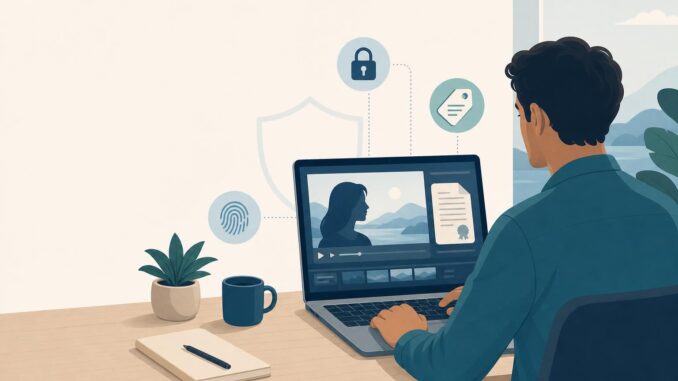
AI tools that create or modify human likenesses are now widely available. Whether you’re a creator, marketer, or small business commissioning AI-generated videos, protecting the people appearing in your work and documenting permission matters for ethics, reputation, and legal certainty.
Core principles of informed consent for AI-generated likeness
Informed consent for an AI-generated likeness should be clear, specific, and documented. It’s not enough to have a verbal ok; you should record who agreed to what, how the likeness will be used, for how long, and whether derivatives are permitted.
What a good consent covers
- Identity of parties: name and contact for the person giving consent and the producing entity.
- Scope of use: exact uses (platforms, formats, territories) and purposes (advertising, editorial, training data, internal demo).
- Type of likeness created: still images, voice replica, full-motion deepfake, stylized avatar, or motion transfer.
- Retention and sharing: whether source files, face scans, or model outputs will be stored or shared with vendors.
- Duration and termination: how long consent applies and conditions to withdraw (if any).
- Compensation and credit: one-time fee, recurring payments, or other considerations.
- Risks and limitations: known risks (loss of control, reuse by third parties) and technical limits of removal.
- Contact and dispute process: who to contact if the person objects later and what the remedial steps are.
Actionable steps to collect informed consent
- Create a written consent form that maps to the items above. Use plain language for non-legal participants.
- Explain the AI workflow to the person: what source material you’ll capture, how it will be processed, and where outputs will appear.
- Get a dated, signed copy. For remote contributors, use e-signature or recorded verbal consent with a timestamp and witness.
- Attach a short summary sheet the person keeps that lists the key rights they granted and contact info.
- Store signed forms securely and index them by project, person, and asset so you can prove consent later.
Technical measures: provenance, watermarking, and access controls
Technical provenance helps show how an asset was created and who authorized it. While technical measures don’t replace a legal release, they strengthen accountability and can reduce misuse.
File-level provenance and metadata
- Embed non-readable metadata describing creation tool, author, and consent ID. Use standard fields where possible (XMP, JSON sidecars).
- Keep an immutable audit log for production steps and approvals. A secure timestamped ledger (internal or third-party) can help establish sequence of events.
Visible and invisible watermarks
- Visible watermarking: use a small branded element or label in drafts and review copies. Avoid putting permanent visible marks in final creative unless part of campaign design.
- Invisible watermarking: embed robust, tool-supported markers into video pixels or audio spectrograms that survive common re-encodings. Note: invisible watermarks vary in resilience across codecs and may be removed by determined actors.
- Combine visible and invisible methods for best practical protection and traceability.
Access control and vendor management
- Minimize who can download raw biometric data or full-resolution source files. Grant least privilege to vendors and use temporary access links.
- Require vendors to sign a data processing or confidentiality agreement that references the consent terms and restricts reuse.
- Log access to source files and outputs so you can show who viewed or exported sensitive assets.
Minimum contractual language for creators, brands, and talent
Below are concise sample clauses to include in a model release or freelance agreement. Treat these as drafting examples—not legal advice—and adapt them for your jurisdiction and situation.
Sample clauses (editable)
Grant of rights: “Subject to the terms below, the Contributor grants Producer a non-exclusive/exclusive (choose one) right to use Contributor’s likeness, voice, and performance in AI-generated content for the purposes described in Schedule A, worldwide, in perpetuity/for [term].”
Scope and restrictions: “Producer may create derivatives (including synthetic likenesses) only for the permitted uses listed in Schedule A. Any uses outside Schedule A require additional written consent and compensation.”
Data handling: “Producer will store source scans, session recordings, and model inputs securely, retain them for no longer than [period], and will not share them with third parties except vendors bound by written confidentiality obligations.”
Compensation: “Contributor will receive [payment structure]. If Producer licenses or monetizes a derivative beyond the agreed scope, Contributor will receive additional compensation as set in Schedule B.”
Revocation and remediation: “Contributor may request removal of future use of likeness. Producer will cease further distribution within [reasonable timeframe] and use commercially reasonable efforts to remove or label affected assets; removal of previously distributed copies may not be feasible.”
Indemnity and disputes: “Each party will indemnify the other for breaches of this agreement. Disputes will be handled by [chosen method—mediation/arbitration] in [jurisdiction].”
Production workflow: practical checklist for creators and teams
Integrate consent and protection into your normal production schedule with these steps.
- Pre-production: Draft the consent form and vendor agreements tied to the project scope.
- Onboarding: Explain the AI process to talent; provide the summary sheet and Q&A time before signing.
- Capture: Timestamp source captures, label files with consent IDs, and collect backup signed forms immediately after recording.
- Processing: Apply watermarking and add provenance metadata to review copies; restrict download for raw assets.
- Approval: Share preview with the contributor for sign-off on final synthetic outputs where feasible.
- Archival: Store consent forms and audit logs in a secure, backed-up location with a clear retention schedule.
Incident-response checklist: steps when misuse or disputes happen
- Confirm identity and specifics from the person reporting the issue; request the consent ID and copies of the disputed asset.
- Check your audit logs and metadata to confirm creation date, approvals, and distribution channels.
- If the use exceeds consent, stop further distribution immediately and notify platforms hosting the asset with takedown requests and proof of the issue.
- Offer remediation to the affected person (labeling, removal from future campaigns, financial remedy where appropriate) according to your agreement.
- If the matter escalates, involve legal counsel and preserve all relevant evidence and communications.
Limitations and practical risks
No process is perfect. Invisible watermarks can be removed, metadata stripped, and bad actors may ignore takedown requests. Laws about likeness, biometric data, and deepfakes vary by jurisdiction and may change. Consent that is too broad can still be challenged if a participant later claims they were misled.
Special care is required for vulnerable groups and minors: obtain parental or guardian consent for minors and consider avoiding synthetic likenesses for people unable to provide informed consent.
Conclusion
Combining clear, documented consent with technical provenance, careful vendor controls, and practical contract language gives creators and brands a defensible, ethical foundation for producing AI-generated videos. Build consent into your workflow from the start, keep records organized, and be ready with a defined response process if concerns arise.
FAQ
1. Is a verbal agreement enough for AI-generated likeness?
Verbal consent is weaker than written consent. For AI likeness creation, a dated, signed document (physical or electronic) or a recorded consent session with clear details is strongly recommended to avoid disputes.
2. Can a contributor withdraw consent after an AI likeness is published?
Withdrawal may be possible for future uses, but removing copies already distributed can be difficult. Agreements should specify withdrawal rights and practical remedies. If withdrawal is important, negotiate it before production.
3. Will watermarking always prove provenance?
Watermarking increases traceability but is not foolproof. Visible marks can be cropped; invisible marks can be altered. Treat watermarking as one layer among metadata, audit logs, and contractual controls.
4. Do I need a lawyer to use these templates and clauses?
Templates and sample clauses are useful starting points, but legal requirements vary. For commercial projects or high-risk contexts, consult a lawyer to tailor language and ensure compliance with local laws.