
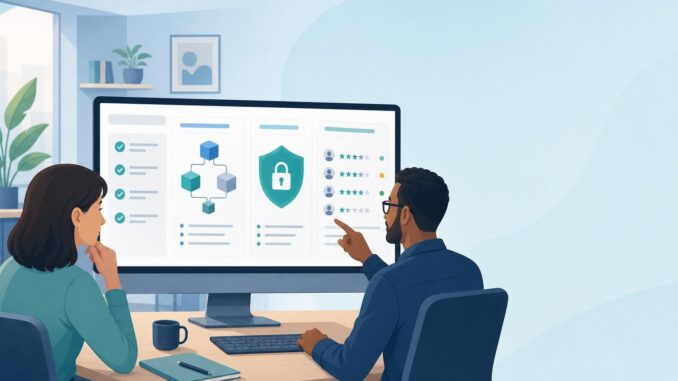
When your small business adopts an AI tool, the model’s training data and the vendor’s privacy practices determine a lot about risk: accidental exposure of customer data, copyright or licensing problems, and how quickly you can respond to breaches or deletions. This guide gives a straightforward AI training data checklist you can use during vendor evaluation, contract negotiation, and routine audits. It’s written for non-specialists and small IT teams who need concrete questions, simple tests, and an easy vendor scorecard.
Core checklist: what to ask, request, and test
1. Ask the vendor these 12 essential questions
- What types of data were used to train the model (public web, licensed, synthetic, customer-provided)?
- Can you provide a provenance summary for data sources used in the model or a model family?
- Do you use customer data for ongoing training or fine-tuning? If yes, how is consent obtained and recorded?
- What retention and deletion policies apply to customer data stored or logged by your service?
- How do you separate or tag customer-provided data to prevent accidental mixing into foundation model training?
- Do you provide versioning and reproducible model instances so we can tie behavior to a known model snapshot?
- What cryptographic and operational protections exist for data at rest and in transit?
- What controls exist to limit model outputs that reproduce verbatim training data?
- How do you detect and respond to data leakage or model extraction attempts?
- What logging, audit trails, and access controls are available to our administrators?
- How will you notify us of breaches, and what is your remediation timeline?
- Can you support contractual clauses requiring deletion, certification, or third-party audit access?
2. Request evidence and contract language
Don’t accept verbal assurances. Ask for written evidence or contract language covering:
- Data inventory or high-level provenance report (not necessarily raw lists, but clear categories and licensing terms).
- Specific representations about whether customer data will be used for further training, and options to opt out.
- Retention limits for logs and user inputs, plus secure deletion procedures and proof-of-deletion on request.
- Liability and indemnity clauses tied to improper training-source use or leakage of customer data.
- Security controls and minimum standards (TLS, role-based access, key management), plus SOC/ISO-like attestations if available.
- Right-to-audit or third-party assessment provisions when appropriate for your risk level.
3. Simple, practical tests you can run or request
Some tests are non-technical; others require a bit more coordination but are feasible for small teams.
- Unique-string probe (contractual test): Give the vendor a distinct, harmless string in a dataset you control and ask them to ingest it. Later, query the model to see if it reproduces that string verbatim. If it does, ask how that data is retained and whether it was used in training.
- Known-sample recall: Provide anonymized examples containing lawful but unique patterns and ask whether the model can be prompted to reproduce them. This helps detect memorization.
- Black-box output testing: Send a range of prompts that could elicit verbatim text (e.g., long descriptive requests) and inspect outputs for repeated blocks that suggest copying from training sources.
- Metadata and logs review: Request redacted logs showing how your data was processed and where it is stored. Check whether personally identifiable information (PII) is being logged in plain text.
- Third-party scans: When feasible, ask the vendor to run a code or data safety scan from an independent assessor and share findings or remediation steps.
Red flags and warning signs
- Vague or no answers about data sources and licensing. If a vendor cannot provide a high-level provenance statement, that’s a concern.
- Automatic use of customer inputs for ongoing training without explicit opt-in, or no clear opt-out mechanism.
- No versioning or inability to reproduce past model behavior—this makes incident investigation difficult.
- Absence of clear deletion procedures or refusal to provide proof of deletion when requested.
- Weak logging and access controls, or no independent attestations (unless vendor is very small and transparent about compensating controls).
Vendor scorecard: a simple decision tool
Score vendors across five categories to make decisions repeatable. Rate each category 0–3, where 0 = unacceptable, 3 = excellent. Totals guide go/no-go decisions.
- Data provenance & licensing (0–3): Does the vendor document training sources and licensing for major data sets?
- Use of customer data (0–3): Can customers opt out of model training? Are inputs segregated or tagged?
- Retention & deletion (0–3): Are retention periods explicit and deletions verifiable?
- Security & access controls (0–3): Encryption, RBAC, logging, and breach processes?
- Transparency & auditability (0–3): Versioning, reproducible snapshots, audit or third-party reports?
A total of 12–15: strong candidate. 8–11: acceptable with required contract clauses or compensating controls. 0–7: high risk; require remediation or choose another vendor.
Operational steps for ongoing assurance
Include checks in onboarding
Make the checklist part of vendor onboarding. Require the vendor to sign contract clauses and provide the requested artifacts before you integrate the tool with production systems.
Periodic reviews and automated monitoring
- Schedule periodic vendor reviews that re-run the simple tests and re-check evidence.
- Log and monitor model outputs for unusually verbatim or unexpected content. If your workflows generate logs, scan them for leaked PII or internal phrases.
- Maintain a change log when the vendor updates models or changes training practices; require notification of major retraining events.
Practical examples and contract wording snippets
Here are short, plain-language examples you can adapt. These aren’t legal advice—have your counsel review any final text.
- “Vendor warrants that customer-provided data will not be used to train foundation models without explicit written consent. Vendor will maintain logical separation and tagging to prevent mixing customer inputs into general training pipelines.”
- “Vendor agrees to delete customer data within X days of request and to provide a signed certificate of deletion showing the data identifiers removed.”
- “Vendor will provide a provenance summary for training datasets used to create the model instance in production, including categories of sources and licensing status.”
- “Vendor will notify customer within Y business days of any incident involving potential disclosure of customer data and disclose remediation steps.”
Limitations and realistic expectations
No checklist eliminates all risk. Vendors may use complex model families built from many data sources, and absolute transparency can be limited by NDAs or third-party licenses. Tests can produce false negatives: a model might not reproduce a sample during your checks yet still be trained on similar content. Also expect trade-offs—strict contractual controls and audits add time and cost, and some vendors may walk away rather than accept heavy contractual obligations.
Conclusion
Using this AI training data checklist helps you move from intuition to repeatable decisions. Ask direct questions, require written proof and contract language, run simple tests, and use the vendor scorecard to compare alternatives. For many small businesses the goal is reasonable assurance—not perfection: document expectations, monitor behavior, and build contractual rights so you can respond quickly if problems arise.
FAQ
1. How technical do I need to be to use this checklist?
Not very. The checklist focuses on questions, contract language, and straightforward tests you can run or request. For deeper technical validation you can hire a consultant or request a third-party audit.
2. Can vendors refuse to provide provenance details for proprietary models?
Some vendors may limit detail due to third-party licensing or trade secrets. In that case, negotiate for alternative assurances: independent audits, stronger deletion rights, or tighter guarantees about not using customer data for retraining.
3. What if a vendor says they don’t keep logs or can’t delete data?
That’s a red flag. Ask for precise policies and technical controls. If they truly can’t or won’t delete or restrict retention, consider whether the risk fits your business needs or look for vendors that support deletion and retention controls.
4. Should I run the same tests on open-source models or local deployments?
Yes. The same principles apply: document the data used to train your model, segregate customer data, maintain versioning, and test for memorization or leakage. Open-source models may require more hands-on work to inspect data and retraining processes.